"Failure to plan is planning to fail" - Winston Churchill.
"It is better to be roughly right than precisely wrong." - John Meynard Keynes
Planning should enable us to take right and reliable decision. Don't get me wrong, I am not asking for precise estimation.
 I strongly believe in quick and rough estimation which evolves as time pass through.
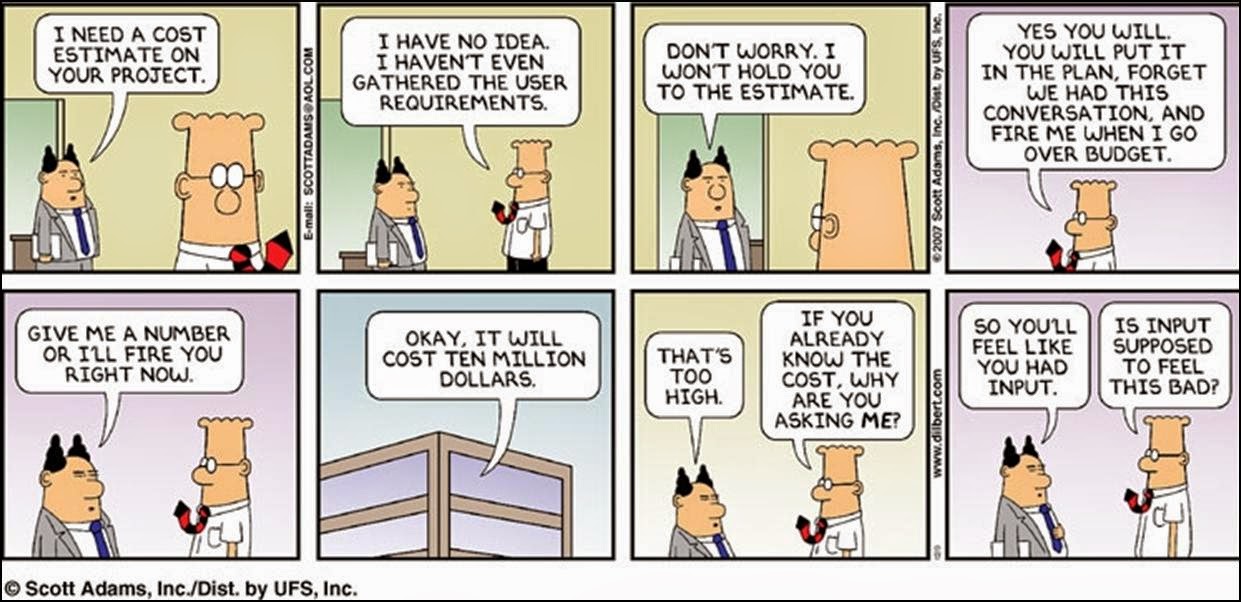 In this post, I am leaning more towards what impact, human behavior and type of work we do, make on our rough estimated number.
When we think we always think like below: Work (3 days) + local Buffer (1 day)
But while executing we feel very optimistic to finish the task in 3 days and we start with cleaning technical debt, preparing some flow for project or documents etc.
We behave reverse i.e. Local Buffer (1 day) + Work ( 3 days)
Finally I started my work and my work took 4 days. I ended up delaying the schedule vs. finishing on time. I had local buffer but it did not help. Therefore having shorter iteration in development cycle might help in keeping the focus vs. big iteration.
For some technical reason task A took 5 days. Now obvious question would be to think what impact would it have on tasks Y and Z? Developers would mostly say other tasks would finish in 2 days each, since I learnt a lot while finishing task X.
You might think that our new estimate for feature A is 10 days vs. 8 days. If the tasks in feature A are independent to each other, than this new estimate might be good but in most cases if task X took 1 days longer there are possibilities that task Y and Z might take longer too. Therefore for any revision, look for inter-dependency within tasks for more accurate estimates.
my experience
Manisha
"It is better to be roughly right than precisely wrong." - John Meynard Keynes
Planning should enable us to take right and reliable decision. Don't get me wrong, I am not asking for precise estimation.
Student Syndrome or waiting till last responsible moment ;)
Student Syndrome, refers to waiting to start a task until the last possible moment that does not preclude on time finish. (This is human nature and very difficult to change.) Lets take same feature A example. As a developer, I thought task X should not take more than 3 days but I kept one day buffer and said 4 days.When we think we always think like below: Work (3 days) + local Buffer (1 day)
But while executing we feel very optimistic to finish the task in 3 days and we start with cleaning technical debt, preparing some flow for project or documents etc.
We behave reverse i.e. Local Buffer (1 day) + Work ( 3 days)
Finally I started my work and my work took 4 days. I ended up delaying the schedule vs. finishing on time. I had local buffer but it did not help. Therefore having shorter iteration in development cycle might help in keeping the focus vs. big iteration.
Lateness passed down (Central Limit theorem does not apply for software)
Software tasks are mostly dependent upon each other, hence the impact of delay of one task may cause delay in other another too. Let me elaborate what I mean by this. Lets estimate a feature A, which has 3 tasks X, Y, Z. Task X would take 4 days to finish. Y and Z subsequently would take 2 days each. So initial estimate for feature A is 8 days.For some technical reason task A took 5 days. Now obvious question would be to think what impact would it have on tasks Y and Z? Developers would mostly say other tasks would finish in 2 days each, since I learnt a lot while finishing task X.
You might think that our new estimate for feature A is 10 days vs. 8 days. If the tasks in feature A are independent to each other, than this new estimate might be good but in most cases if task X took 1 days longer there are possibilities that task Y and Z might take longer too. Therefore for any revision, look for inter-dependency within tasks for more accurate estimates.
my experience
Manisha
